
Ford AI Chat Bot
Ford asked for a more competitive way to show consumers how they have a competitive advantage against other automobile companies. I decided to create a comparative, open-ended AI chatbot for their website. See below for more.
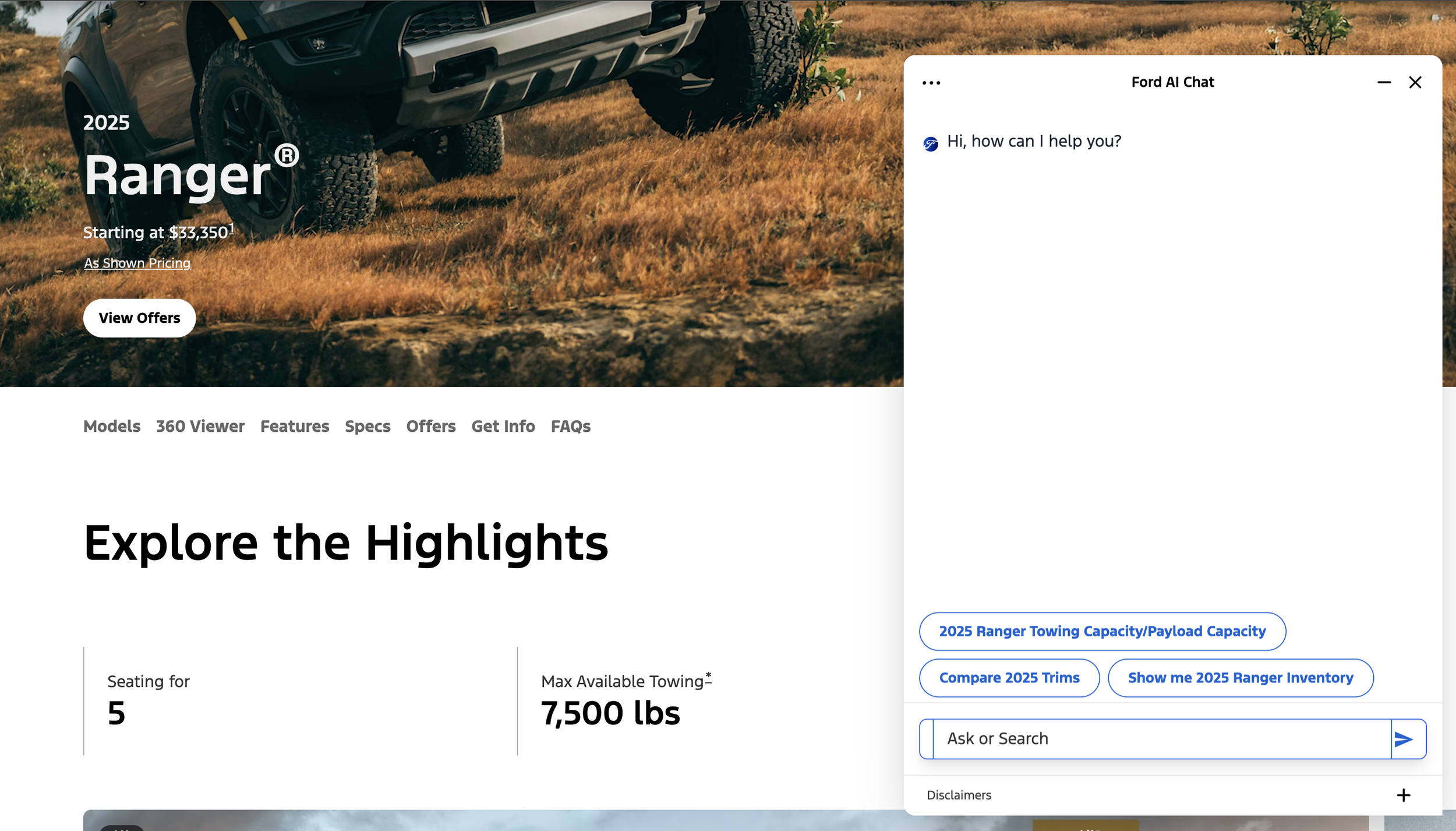
Overview: Ford Motor Company is one of the most recognized automotive brands globally, with millions of customers researching, purchasing, and owning vehicles through its digital ecosystem. As the brand continues to expand its online experience, customers increasingly look for quick, accurate, and human-centered support when exploring models, learning features, or navigating ownership tasks.
The aim of this project was to design an AI-powered chat experience for Ford.com that simplifies learning, reduces confusion, and provides clear, conversational guidance. The chatbot helps customers compare vehicles, understand features, and find the information they need in a more intuitive and interactive way.
Client:
Ford Motor Company
Role and Duration
July - November 2025
Digital Designer Intern | VML MAP Austin, TX
Led the visual design, conversational UI patterns, and interactive prototype for the Ford AI chatbot. Collaborated with product and engineering teams to shape user flows, tone, and on-site experience.
The Problem
Ford asked us to develop a solution that would differentiate their digital experience and give them a stronger competitive edge in the automotive market.
Customers today expect fast, conversational, and clear support when making big decisions like purchasing a vehicle. Ford’s existing tools required users to search, navigate, and interpret information on their own, which could feel overwhelming. There was a need for a more human, guided, and supportive digital experience.
User Research
Who We Focused On
Vehicle shoppers comparing models online
First-time EV buyers trying to understand new technology
Current Ford owners seeking quick support or how-to guidance
Insights
Core Insights
I was able to categorize the insights into five categories:
1. Customers want answers quickly.
Users reported frustration with having to click through multiple pages or PDFs to find simple information like feature differences or charging details.
2. Vehicle research can feel overwhelming.
There are many models, trim levels, packages, and specs. People needed guidance, not more data.
3. EV education creates a new layer of confusion.
Charging, range, battery health, and at-home setup were common high-anxiety ‘topics.
4. Ownership questions are often urgent and emotional.
When something goes wrong, people want reassurance and clarity immediately.
5. Human tone > marketing tone.
Users respond better to conversational guidance rather than heavy product language.
Observed Behavior Patterns
People often asked the same questions repeatedly (pattern recognition opportunity).
Users skimmed or avoided long paragraphs and spec tables.
Many turned to third-party sources (YouTube, Reddit, forums) instead of Ford’s site.
Confidence increased when information felt personalized to their exact model or situation.
What This Told Us
Customers didn’t need more information, they needed a faster and more human way to access it.
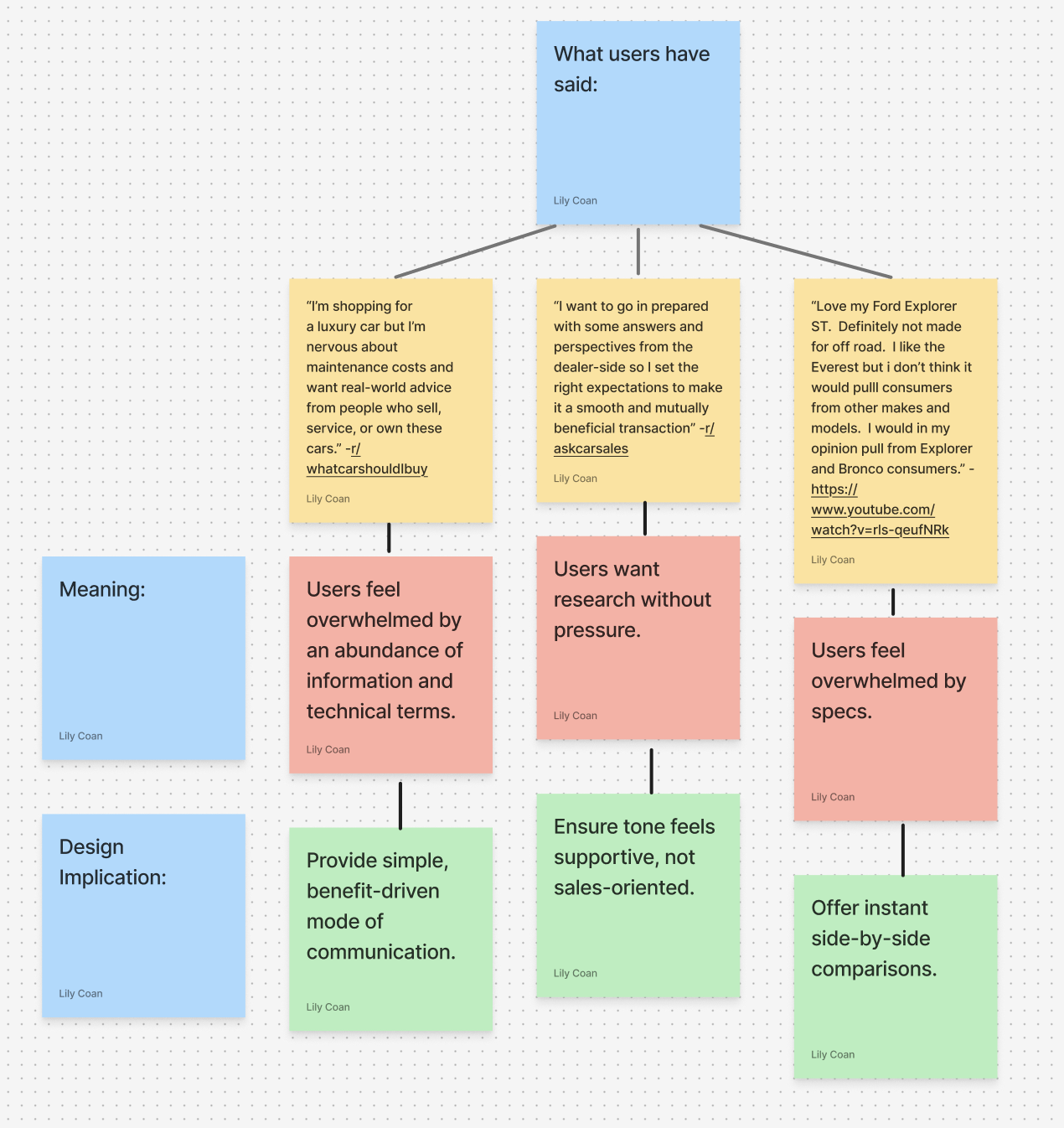
Customers were overwhelmed by information and wanted guidance that felt fast, clear, and conversational, not another page of specs.
User Profiles
The research showed how different users would use the AI chat bot differently. To meet these needs, I categorized them into three different personas.
-
Feels overwhelmed by specs and trims
Needs simple explanations, wants to compare models
-
Doesn’t want to dig through multiple pages
Wants direct answers about features/changes/maintenance
-
Gets frustrated when info is buried or unclear
Wants detailed, technical info quickly
Journey Pain Points
Through observation, we identified key pain points in the current Ford.com vehicle research experience:
Information was fragmented across multiple pages and comparison tools.
Trim levels and feature differences were hard to interpret, leading to confusion.
Users often felt overwhelmed by technical specs without context.
Many didn’t want to call a dealership yet, but still needed clarification.
The experience didn’t adapt to different research styles (quick answers vs deep dives).
These barriers slowed decision-making and made users feel less confident during an already high-stakes purchase process.
Opportunity
There was an opportunity to introduce guidance, clarity, and reassurance directly into the research flow.
Opportunity Statement:
Design a conversational AI experience that meets users where they are , simplifying complex vehicle information, answering questions in real time, and empowering customers to explore confidently, on their own terms.
This would position Ford as:
More approachable
More helpful
More technologically progressive
More aligned with how users make decisions today
The Solution
We created the Ford AI Vehicle Guide, an intelligent chat experience integrated into Ford.com.
The chatbot:
Answers questions in natural, human language
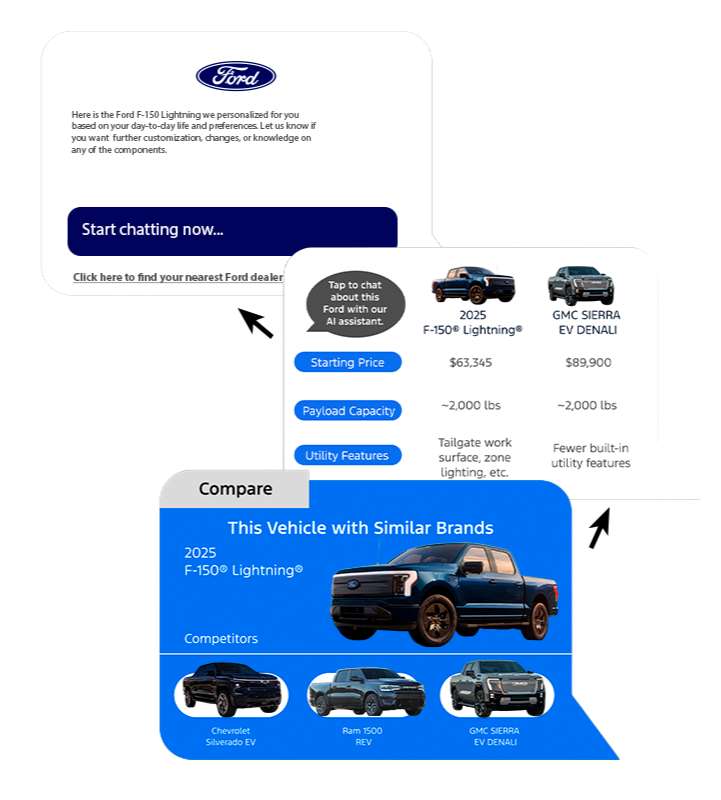
Provides clear comparisons between models and trims
Helps users understand benefits, not just specs
Learns from user intent to provide personalized guidance
Reduces reliance on generic browsing and multi-step navigation
Users can simply ask what they need, and get the right information immediately, without pressure or complexity.

UI + Interaction Design
I led the UI design and interaction prototyping, ensuring the experience felt intuitive, brand-aligned, and supportive:
Designed a conversational interface that feels friendly, modern, and trustworthy
Created visual answer cards to break down complex info into digestible chunks
Built model comparison responses that clearly highlight differences in features and performance
Developed tone and response style guidelines to ensure the AI always feels:
Helpful, not salesy
Knowledgeable, but approachable
Clear, not overly simplified
Prototype
I worked closely with a Solutions Engineer to create a functional prototype of the AI chat bot.
Learnings and Outcomes
Reduced confusion when comparing vehicles.
The experience helped build confidence earlier in the research journey
The chatbot lowers reliance on call centers for basic information
Stakeholders identified future expansions into:
Dealer chat hand-offs
Financing guidance
Service + maintenance support
Key Learning:
Simply answering questions isn’t enough- Users need to feel understood. The success of the experience came from designing the tone, guidance style, and emotional reassurance, not just the information itself.